Find a Branch

Our History: NexTier Bank, Pennsylvania Community Banking Since 1892

Chartered in Butler, Pennsylvania during the oil-boom era of 1892, NexTier Bank has financed farmland, steel payrolls, shale-gas contractors and the Main-Street shopkeepers that have built Western Pennsylvania for more than 130 years. The name changed in 2004 after a merger of local community institutions, but the philosophy — hometown deposits funding hometown loans — did not.

Today the bank operates 17 full-service branches across Butler, Armstrong and Westmoreland counties, holds roughly $1.5 billion in assets under management, and serves more than 40,000 households and businesses. The institution remains FDIC-insured, Equal Housing Lender, Preferred SBA lender, and regulated by the Pennsylvania Department of Banking and Securities.

Executive Findings: 130+ Years of Western Pennsylvania Banking

A chartered community bank in Butler County, operating through every major economic era of the Commonwealth.

NexTier Bank traces its corporate lineage to an 1892 state banking charter issued in Butler, Pennsylvania, a county seat 33 miles north of Pittsburgh. The region was then riding the second wave of the Pennsylvania oil boom; Butler-area wildcat drillers, oil-field machinists and the pipeline crews that followed needed a deposit institution that understood lease payments, royalty cycles and equipment financing. The founding charter was written for exactly that local economy.

Through the first half of the twentieth century the bank financed steel-adjacent suppliers along the Allegheny River, the rail spurs that carried coke into Pittsburgh mills, and the farms that fed the industrial workforce. The 1930s were survived without federal rescue, a point still referenced in board minutes. Post-war expansion pushed branches into Armstrong and Westmoreland counties as Western Pennsylvania communities grew around the mill towns.

The modern NexTier identity was formed in 2004 when several long-standing Butler-area community banks combined into a single Pennsylvania-chartered institution under shared holding-company ownership. The consolidation preserved every branch location, every local mortgage officer and every commercial-banking relationship — it simply produced a single balance sheet capable of underwriting larger Main Street transactions without syndicating out of region.

Milestones: 1892 to Today

Six defining moments from 130+ years of Pennsylvania community banking.

YearEventImpact
1892Original state bank chartered in Butler, PAFirst deposit institution purpose-built for the Butler oil economy
1934FDIC membership adopted under Banking ActFederal deposit insurance extended to every Butler-area accountholder
1977Community Reinvestment Act compliance framework adoptedFormal reinvestment commitments to Butler, Armstrong and Westmoreland counties
2004Merger of local community banks under NexTier nameSingle balance sheet capable of larger Main Street lending
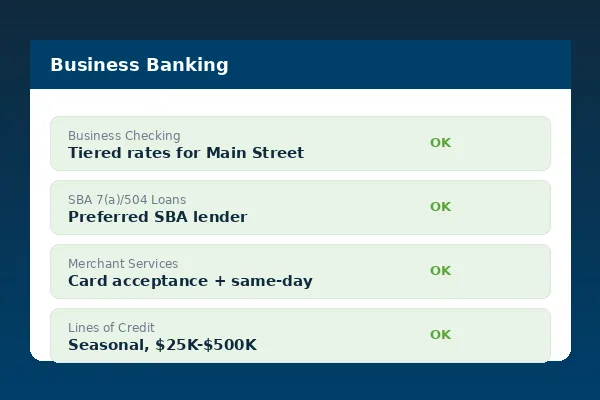
2014Preferred SBA Lender status grantedIn-house SBA 7(a) and 504 decisioning, saving weeks of closing time
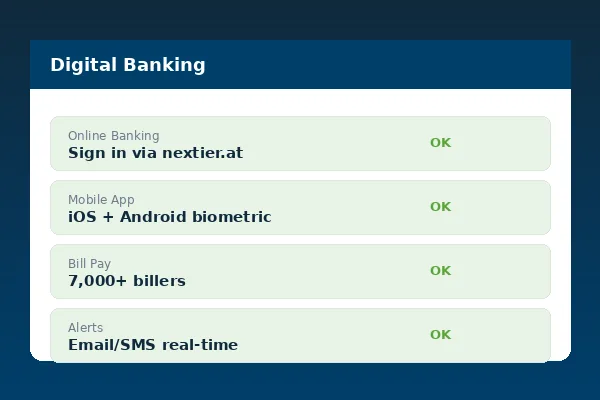
2023Mobile app biometric sign-in and real-time alerts rolled outDigital banking modernized without losing branch-first service model

The Community Banking Philosophy

What distinguishes a Pennsylvania-chartered community institution from a money-center chain.

Deposits Fund Local Loans

A dollar deposited at a Butler branch is far more likely to fund a Butler mortgage, a Kittanning contractor’s SBA loan, or a Vandergrift small-business line of credit than it would be at a coastal mega-bank. The community-bank model deliberately keeps loan-to-deposit circulation inside the same region the deposits came from.

According to research cited by the Federal Reserve, small community banks originate a share of small-business lending that exceeds their share of banking assets — a direct consequence of the local-underwriting model the Butler institution has used since 1892.
Historic Butler main-office branch of NexTier Bank with classical architecture and hometown signage
Commercial lending office at NexTier Bank Butler with relationship banker meeting local contractor client

Decisions Made in Butler

Every mortgage, commercial credit and SBA-backed loan at the institution is underwritten inside Butler County. A borrower’s file does not board a flight to a national loan center. The officer who takes the application is the same officer the borrower can walk in and see the following week. That matters most on judgement-call credits — new farms, first-time buyers with thin file history, or a contractor whose books show seasonal swings that an algorithmic underwriter would flag.

CRA examinations by federal regulators have rated the bank Outstanding in its most recent public evaluation, a reflection of sustained lending into low- and moderate-income census tracts in the three-county footprint.

Western Pennsylvania Economic Eras

The institution has financed customers through the original oil boom, the steel century, the post-industrial transition, the natural-gas shale decade, and the current Main-Street small-business recovery. Each cycle brought different credit patterns — mineral-rights leases in the 2010s, contractor expansion after the Marcellus and Utica activity, and a return of agricultural lending as Butler County farmland values stabilized.

For consumer protection context the Consumer Financial Protection Bureau tracks community-bank complaint rates that consistently run below those of large national chains, reinforcing why Western Pennsylvania households stay with their local institution across generations.

Western Pennsylvania historical economic eras infographic with oil boom, steel era, shale gas and modern small business phases

By the Numbers

A Pennsylvania community institution at scale.

1892Year Chartered
17Branches
230Team Members
40K+Households & Businesses

Community Credentials

Regional recognition for Pennsylvania community banking performance.

"Three Generations at the Same Branch"

"My grandfather opened his first savings passbook at the Butler main office in 1956. My mother financed her 1983 farmhouse mortgage there. In 2023 my wife and I closed on our own home with the same local underwriting team. The continuity is real — the bank has kept its footing through every Western PA cycle I have witnessed."

— Ronald B., Generational Customer, Saxonburg, PA

"CRA Partnership That Delivers"

"Our affordable-housing nonprofit has partnered with the community lending team on four Butler-area projects. Every one of them closed on the promised timeline. The CRA commitment is not a checkbox — it is a standing line item that local directors actually advocate for in board meetings."

— Patricia K., Executive Director, Butler County Housing Partnership

"The Only Bank My Farm Has Used"

"Our dairy operation in Armstrong County has been financed through this bank since my father bought the parcel in 1971. Equipment notes, barn expansion, crop-cycle operating lines — always local officers who understand a dairy balance sheet. No national chain has ever matched that working knowledge."

— Douglas M., Third-Generation Dairy Owner, Laurel Highlands Farm Supply (Kittanning, PA)

Frequently Asked Questions

When was NexTier Bank founded?
Chartered in Butler, PA in 1892 under Pennsylvania banking law. The current NexTier identity was adopted in 2004 after a merger of local community banks. Supervised today by the Pennsylvania Department of Banking and Securities and the FDIC.
Who owns NexTier Bank?
A Pennsylvania-based holding company with shareholders drawn from local investors, directors, employees and community supporters. Board governance is recruited from Western Pennsylvania civic and business leadership, keeping capital and decisions in Butler County.
What makes a community bank different?
Local underwriting, relationship continuity, deposits recirculated as loans in the same region, and in-state regulatory oversight. National chains optimize for portfolio statistics; community banks optimize for borrower context and long-cycle customer relationships.
What is the CRA rating?
Outstanding in the most recent Community Reinvestment Act public performance evaluation. Reflects sustained lending in low- and moderate-income census tracts across Butler, Armstrong and Westmoreland counties.
How many employees work at the bank?
Approximately 230 team members across 17 branches, the Butler operations center, mortgage, commercial and digital banking teams. Most live in the same three counties they serve.

Community Banking Resources — Topic Cluster