Find a Branch

Business Loans at NexTier Bank: Term and Operating Line Credit

Capital for operators who run Main Street businesses across Butler, Armstrong and Westmoreland counties. NexTier Bank underwrites term loans, revolving lines of credit, equipment finance, inventory financing and receivables financing locally — every credit decision made in Butler County by bankers who know the regional economy.

For owner-occupied commercial real estate, see the dedicated commercial real estate page. For SBA 7(a) and 504 structures backed by federal guaranty, see the SBA loans page. Reach the commercial team at 724-287-8781 extension 1200.

Talk to a Commercial Banker Explore SBA Structures
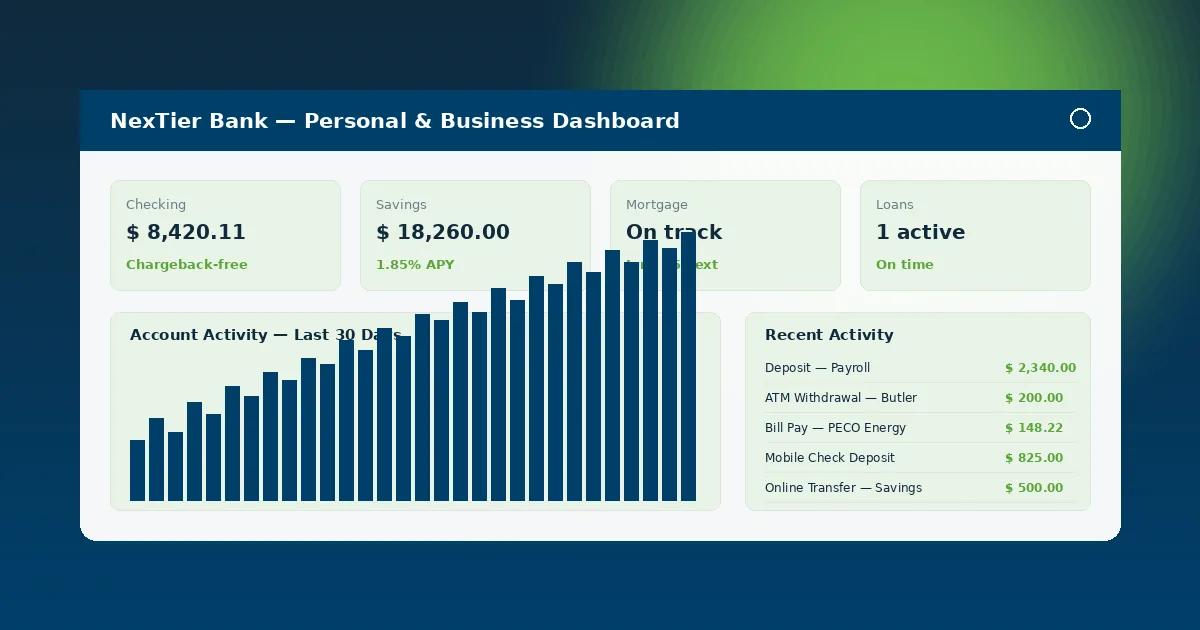
NexTier Bank business loan dashboard showing term amortisation, line of credit available balance, equipment finance and receivables borrowing base

Business Lending Snapshot: Six Credit Structures for Six Different Needs

The right facility depends on whether the capital is one-time or ongoing, secured by specific collateral, and how cash flow converts into debt service.

Business Term Loan

Lump-sum capital from $10,000 to $1,000,000, amortised over one to ten years. Fixed or variable rate. Funds equipment, build-out, acquisitions, vehicle fleets, soft-cost capital. Requires two years of business tax returns, interim financials and personal financial statement on majority owners. Collateral varies by request.

Business Line of Credit

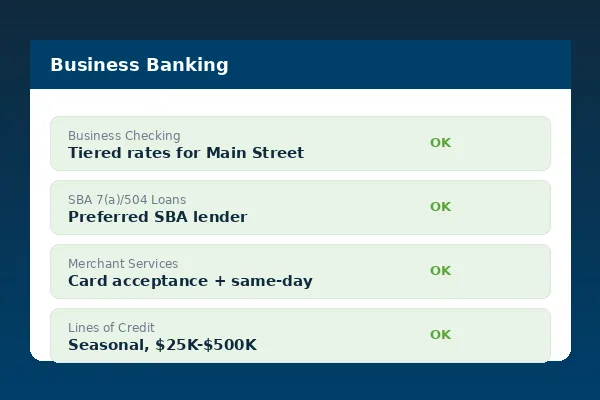
Revolving facility $25,000 to $500,000 for seasonal working capital, bridging receivables or opportunistic buys. Annual renewal, variable rate over Prime. Draw and repay as cash flow dictates — interest only on outstanding balance. Operators often hold a line alongside a term loan to cover both permanent and seasonal capital needs.

Equipment Finance

Amortisation matched to useful life of the asset. Equipment itself serves as primary collateral, UCC-1 recorded. Best for machinery, trucks, vehicles, POS hardware, restaurant equipment. Sale-leaseback available to free capital from existing owned equipment. Fixed-rate pricing is common to provide payment predictability.

Inventory Financing

Revolving advance against eligible inventory for distributors, retailers and manufacturers with meaningful stock on hand. Borrowing-base certificates updated monthly. Advance rate 40% to 60% of eligible inventory depending on category velocity and obsolescence risk. Often blended with a receivables line into a single asset-based revolver.

Receivables Financing

Advance 70% to 85% of eligible A/R balances for B2B operators with net-30 or net-60 invoicing. Structured as a revolving loan against receivables — not factoring. The operator continues to bill and collect; the bank lends against the asset. Monthly borrowing-base certificate reconciles availability.

Owner-Occupied CRE

Separate underwriting track covered on the commercial real estate page. Used when the operator owns the building — manufacturing, warehousing, office, medical, retail. Local appraisal, DSCR analysis, typical 20-to-25-year amortisation with shorter balloon or call dates.

Facility Comparison Table

Amount brackets, typical term structures and best-fit use cases across the business loan product set.

FacilityAmountTermRate TypeBest For
Business Term Loan$10,000 - $1,000,0001-10 yearsFixed or variableEquipment, build-out, acquisitions
Business Line of Credit$25,000 - $500,000Annual renewalVariable (Prime-indexed)Seasonal working capital
Equipment Finance$25,000 - $1,000,0003-10 years (useful life)FixedMachinery, vehicles, POS
Inventory Financing$100,000 - $1,000,000Annual, revolvingVariableDistributors, retailers with stock
Receivables Financing$100,000 - $1,000,000Annual, revolvingVariableB2B with net-30/60 invoicing
Owner-Occupied CRE$100,000 - $5,000,00020-25 years amortisationFixed balloonOperator-owned building
SBA 7(a) / 504Up to $5,000,00010-25 yearsVariable or fixedProjects needing federal guaranty

Underwriting That Happens in Butler County

Community-bank lending pairs judgement with local context. Decisions in days, not weeks.

LocalUnderwritten in Butler County
7-14Days typical close for small requests
DSCR1.20x typical minimum
Reg BEqual Credit Opportunity Act compliant

How Local Underwriting Actually Helps

Three situations where a community bank makes a better credit decision than a national chain with remote underwriting.

Seasonal Cash-Flow Reading

A landscape contractor shows seasonally lumpy revenue — high March through October, quiet December through February. A scoring model in Charlotte flags irregularity. A Butler County banker reads the pattern as normal and sizes a $150,000 line of credit to bridge winter expenses. Reliable for 20 consecutive years, no default.

The Federal Reserve community banking research documents this pattern: small community banks originate a disproportionate share of small-business credit relative to asset size because they translate local knowledge into credit decisions.
Seasonal cash flow analysis showing quarterly revenue pattern with line of credit draws against winter expenses
Equipment loan with UCC-1 filing and useful-life amortisation matching machinery lifespan

Equipment Useful Life as Term

A machine shop buying a $385,000 CNC lathe wants 10-year amortisation to keep payments in line with projected incremental revenue. The bank matches term to useful life, secures with a UCC-1 on the machine, and holds a personal guaranty from the majority owner. Fixed-rate pricing at closing removes interest-rate risk over the depreciation cycle.

Credit structure follows Reg Z disclosure requirements and applicable commercial-lending regulation. Sale-leaseback on existing owned equipment is a parallel capital source for operators wanting to free trapped equity.

Asset-Based Revolver for Distributors

A Western PA wholesale distributor with $6M annual sales runs an asset-based revolver blending inventory and A/R. Monthly borrowing-base certificates reconcile eligible collateral against outstanding balance. Structure supports growth without requiring owners to re-inject equity every time the business scales. DSCR covenant typically 1.20x, reviewed annually with fresh financials.

Covenant package is proportionate to facility size and risk. The goal is a workable partnership, not an adversarial compliance exercise. CTR reporting and other FDIC Bank Secrecy Act obligations are handled by the bank on the operator's behalf.

Asset-based revolver with borrowing base certificate, inventory eligibility and accounts receivable aging

Related Services at NexTier Bank

Business credit is usually one piece of a broader banking relationship. These are the natural companions.

Business Banking Companions

Business checking, business savings, commercial real estate, merchant services and SBA loans tie directly to most credit relationships.

Personal Banking for Owners

Owner personal guaranty relationships often pair with personal checking, personal loans, mortgages and auto loans consolidated at the same bank.

Digital Operations

Loan payments, statements and covenant reporting run through online banking, mobile banking, alerts and eStatements.

Start a Business Loan Conversation

Bring two years of business tax returns, most recent interim financials, a personal financial statement and a description of the capital need. Call 1-800-262-8215 or reach the commercial line at 724-287-8781 ext. 1200.

Find a Branch

People Also Ask

What business term loan amounts are approved?
$10,000 to $1,000,000 over one to ten years. Fixed or variable. Underwriting reviews two years of business tax returns, interim financials and personal financial statement on majority owners.
How does a line of credit differ from a term loan?
A line revolves — draw, repay, draw again up to the limit. Best for seasonal working capital. A term loan is a lump sum with scheduled amortisation — best for one-time projects. Operators often hold both.
Can equipment financing match useful life?
Yes. Term matches expected useful life — 3-5 years for vehicles, 5-10 for machinery. Equipment serves as collateral with UCC-1 filed. Fixed-rate pricing is common.
Do you offer receivables financing?
Yes — 70-85% advance against eligible A/R for B2B operators with net-30 or net-60 invoicing. Structured as a revolving loan, not factoring. Operator continues to bill and collect.
How fast can a business loan close?
Small-dollar term or line renewal for existing customers: 7-14 business days. Larger requests with appraisals, environmental reviews or SBA packaging: 30-60 days.

Community Banking Resources — Topic Cluster